Entrepreneurial Journey
Every system I build began as a problem I refused to keep solving by hand.
Fifteen years across web, automation, software and AI — told as chapters, not bullet points.
2013
First Client, First Platform
The career starts on Freelancer.com — one profile, zero reputation, and a decision to outwork everyone. The early projects teach the fundamentals no course can: how to win a stranger's trust, how to deliver, and how to turn one happy client into the next three.
- Freelancer.com
- First clients
- Reputation from zero
2013–2017
500+ Projects on Freelancer & Upwork
Across Freelancer.com and Upwork, the count passes five hundred completed projects — 450 of them on Freelancer.com alone. Websites, WordPress automation, scrapers, integrations, growth systems. Clients are entrepreneurs from around the world, most of them in the United States. Every project is a masterclass in someone else's business.
- 500+ projects
- Upwork
- WordPress automation
- US clients
2015–2019
Bots Before the AI Wave
Years before AI became a trend, the work turns to making software talk and act: Python bots, LINE bots, Messenger chatbots, automated communication flows. Teaching machines to handle conversations and repetitive work becomes a specialty — and quietly, the foundation for everything that comes later.
- Python bots
- LINE bots
- Chatbots
- Automation
2017–2022
From Freelancer to Founder
The freelance practice becomes a portfolio of real companies: Dresses.com.pk and Pakistanidresses.com.au in cross-border fashion e-commerce, Techagency.ca and Techagency.com.au serving businesses in Canada and Australia, with Swash Enterprises as the corporate home. Different markets, different industries — the same systems thinking underneath.
- Dresses.com.pk
- Pakistanidresses.com.au
- Techagency.ca
- Techagency.com.au
- Swash Enterprises
2013–2022
A Thousand Entrepreneurs
Along the way, roughly a thousand entrepreneurs — most of them in the US — cross the path as clients, partners and founders to build for. The pattern becomes impossible to unsee: ambition is evenly distributed, infrastructure is not. Give a capable person better systems, and their ceiling moves.
- ~1,000 entrepreneurs
- Global clients
- Growth systems
- 3 exits
2022–2024
The Turn to AI
Large language models change the equation. A decade of bots and automation meets technology that can genuinely understand, decide and communicate. The question shifts from 'how do we automate tasks?' to 'how does an entire business operate through intelligence?'
- AI agents
- Voice AI
- LLMs
- Autonomous systems
2024 — Today
Swashi — The AI Agentic Operating System
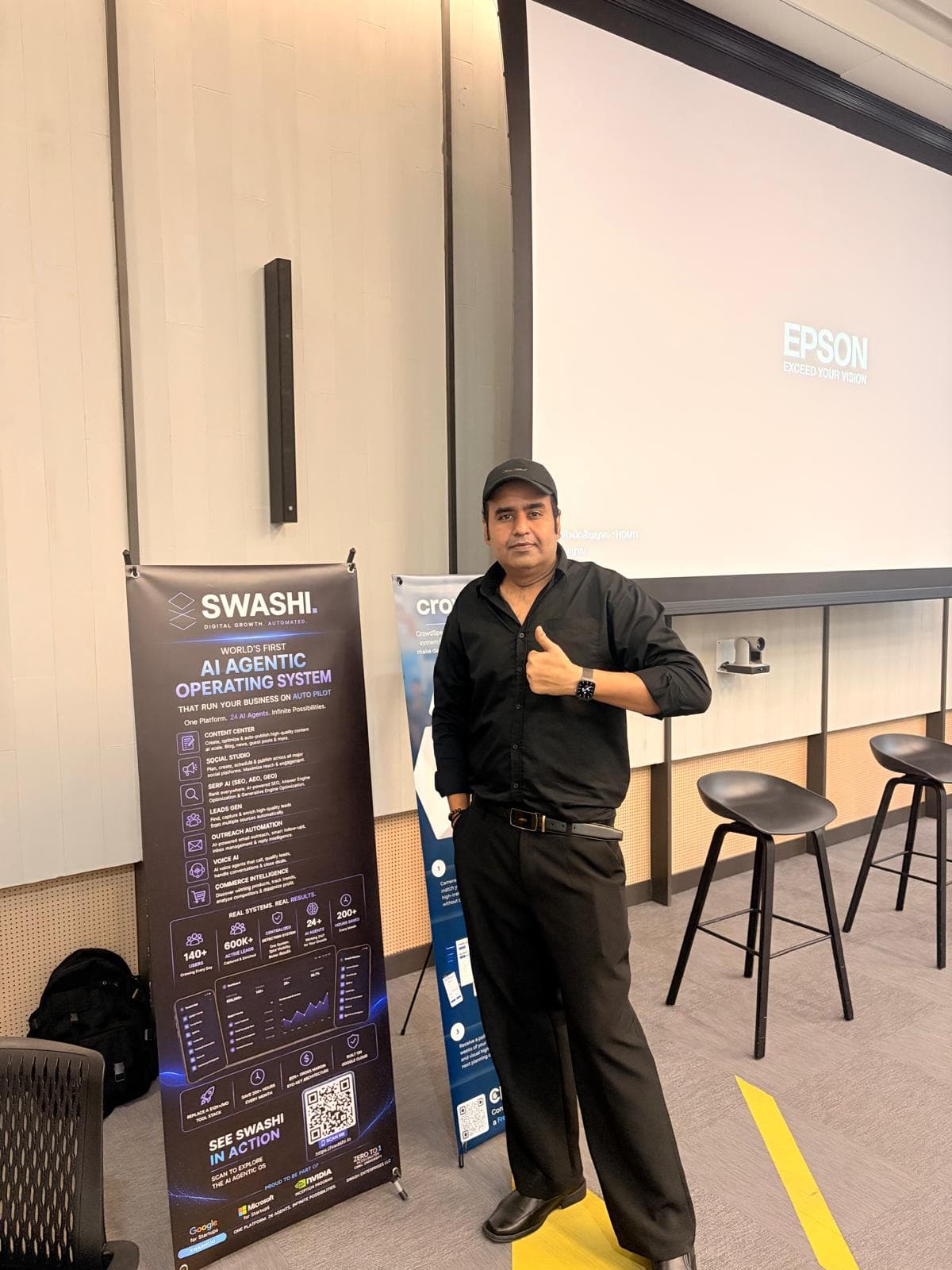
Everything converges. Swashi is an AI Agentic Operating System: one platform where a workforce of AI agents runs a business on autopilot — content, social, SEO, leads, outreach, voice and commerce intelligence, across languages. Part of Google for Startups, Microsoft for Startups and the NVIDIA Inception Program. This is the long game.
- Swashi.io
- 24 AI agents
- Agentic OS
- Multilingual AI
What the years actually taught
Lessons from the Journey
Reputation compounds faster than revenue.
Five hundred projects taught me that every delivery is an advertisement. The freelancer who treats a $50 job like a $50,000 one ends up with the $50,000 clients.
Systems beat effort.
Effort is noble and unscalable. Every business I've seen compound was built on systems that produced results without heroics. The founder's job is to make heroics unnecessary.
Distribution is half the product.
A great product nobody hears about loses to a good product everyone does. I learned to build the selling machine with the same seriousness as the thing being sold.
Be early, but be shipping.
I was building Python bots, LINE bots and chatbots years before AI became a trend. Being early only mattered because the bots shipped and worked. Conviction plus shipping beats perfect timing.
Language is a market boundary.
Selling Pakistani fashion in Australia and building agencies for Canada taught me this early: most software quietly assumes English and one market. The majority of the world's entrepreneurs live outside both.